
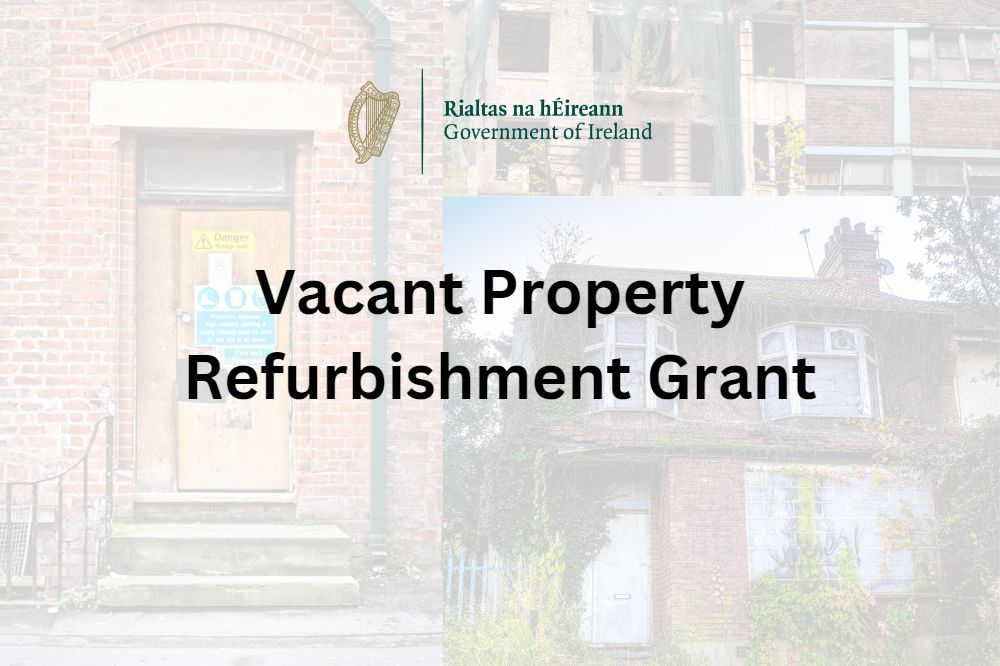
In a property market like we currently have this grant can provide great financial assistance to someone buying an eligible property.
The grant provides funding to renovate vacant and derelict properties for use as residential homes.
A grant of up to €50,000 is available to refurbish vacant properties. For properties that are derelict and structurally unsound/dangerous an additional top-up grant of up to €20,000 may be available. The grants are inclusive of the VAT costs of the works.
Ireland has somewhere in the region of one hundred thousand vacant homes, sitting empty alongside a housing shortage. The Vacant Property Refurbishment Grant exists to close that gap. It is funded through the Croi Conaithe (Towns) Fund and run by your local authority, and it puts real money towards turning an empty building back into a home.
On 31 March 2026 the scheme was expanded. The headline figures most people already know, EUR 50,000 for a vacant property and EUR 70,000 where it is derelict, are still there. What has changed is the range of buildings the grant now reaches, and how much is available when one building is being turned into several homes.
If you are thinking of buying a vacant or derelict property, the grant can completely transform the sums. But it can also catch you out, because the conditions are strict and almost all of them have to be satisfied before you lift a finger on the works.
What the grant covers
The grant helps you refurbish a vacant or derelict property so it can be lived in again, either as your own home or as a property you will make available to rent. Buildings that were never homes in the first place, such as old commercial premises, can qualify too, as long as the right planning permission is in place.
There are two things it will not pay for. It does not cover knocking a property down and rebuilding it, and it does not cover energy efficiency works that are already funded through the Sustainable Energy Authority of Ireland, although you can apply to the SEAI separately for those and use the two schemes together.
The grant levels in 2026
- Up to EUR 50,000 to refurbish a vacant property.
- A top-up of up to EUR 20,000 where the property is confirmed as derelict or is already on the local authority’s Derelict Sites Register, bringing the maximum to EUR 70,000. This applies where the cost of the work is expected to go beyond the standard grant.
- A 20 per cent uplift for properties on offshore islands, which takes those figures to EUR 60,000 and EUR 84,000.
- From 31 March 2026, if you are converting an entire former commercial or public use building into two or more homes, there is a further top-up of up to EUR 20,000 for two units and up to EUR 40,000 for three or more. That takes the maximum to EUR 90,000 for a vacant building with three or more units, and EUR 110,000 for a derelict one.
- Also from 31 March 2026, there is a separate Vacant Above the Shop Grant for turning the empty space above a shop into homes: up to EUR 95,000 for one unit, EUR 115,000 for two, and EUR 135,000 for three or more.
- And if you are weighing up a conversion of this kind, an Expert Advice Grant of up to EUR 5,000 can help with the cost of professional advice before you apply.
Bear in mind that all of these figures are maximums, they include VAT, and your local authority will assess the costs against the funding limits set for each category of work. If the job ends up costing more than the grant, the balance comes out of your pocket.
Who qualifies
- The property must have been vacant for at least two years immediately before you apply.
- It must have been built in 2007 or earlier.
- You must own the property, or be able to show that you are actively negotiating to buy it.
- Applications have to be made by named owners, so a registered company cannot apply.
- You must be tax compliant, and up to date with Local Property Tax where it applies.
- You can claim the grant twice in total: once for a home you will live in, and once for a property you will rent out.
Proving the property has been vacant for two years
This is the part where a buyer most often needs their solicitor, and where we would ask you to think ahead.
When you are buying, ask the seller for utility bills covering the full two-year period, showing that the property has not been in use. If those bills are not available, the local authority may accept a signed affidavit from the vendor instead, which is a sworn written statement. Where we act for purchasers, we ask for both, because an affidavit on its own leaves you depending on the goodwill of someone who has already been paid.
The same thinking applies to a property you have inherited. If the person who died owned the property in their sole name, probate will usually be required before you can deal with it at all, and you will need vacancy evidence covering the period since the death as well as before it. It is worth knowing that a property left vacant because of the illness or death of its owner may be exempt from the Vacant Homes Tax, although that is a separate question from whether you qualify for the grant.
The conditions attached
Once the work is finished and inspected, the local authority will ask you to sign a charge document. A charge is a form of security registered against the property, a little like a mortgage, for the amount of the grant, and it stays in place for ten years. In practice, that means:
- You must live in the property as your main home, or make it available to rent with the tenancy registered with the Residential Tenancies Board, for at least five years.
- If you sell up or move out within ten years, the local authority may ask for some or all of the grant back.
- You will need tax clearance from Revenue where the approved grant is more than EUR 10,000.
For someone buying a home to live in, none of this is particularly demanding. It matters a great deal more for anyone treating a vacant property as a short-term project.
How the grant sits alongside the taxes
Vacancy is being taxed as well as subsidised, so the same empty building can attract both a grant and a bill. The Vacant Homes Tax applies to residential properties that are lived in for fewer than thirty days in a chargeable period, and Budget 2026 announced a new Derelict Property Tax to replace the Derelict Site Levy, with the first registers due to be published in 2027.
Then there is the ordinary cost of buying. Stamp duty is payable on the purchase in the usual way, and the grant does not change that. Our conveyancing team can set out the full cost of the transaction before you commit to anything.
Where to check the current rules
The scheme outline and application forms are published by the Department of Housing, Local Government and Heritage on gov.ie, and Citizens Information keeps a plain English summary. Applications go to the Vacant Homes Officer in your local authority, and it is worth knowing that practice does vary from one council to the next.
Thinking of taking on a vacant property?
A grant of up to EUR 70,000, or considerably more where you are creating several homes from one building, is well worth having. It is also well worth getting right. The vacancy evidence, the planning position, the timing of your application against the timing of the works, and the charge that will sit on your title for a decade all need to be sorted out before contracts are signed.
If you are considering a vacant or derelict property, please do get in touch with our friendly team. We would far rather talk to you before you make an offer than after the works have started.