
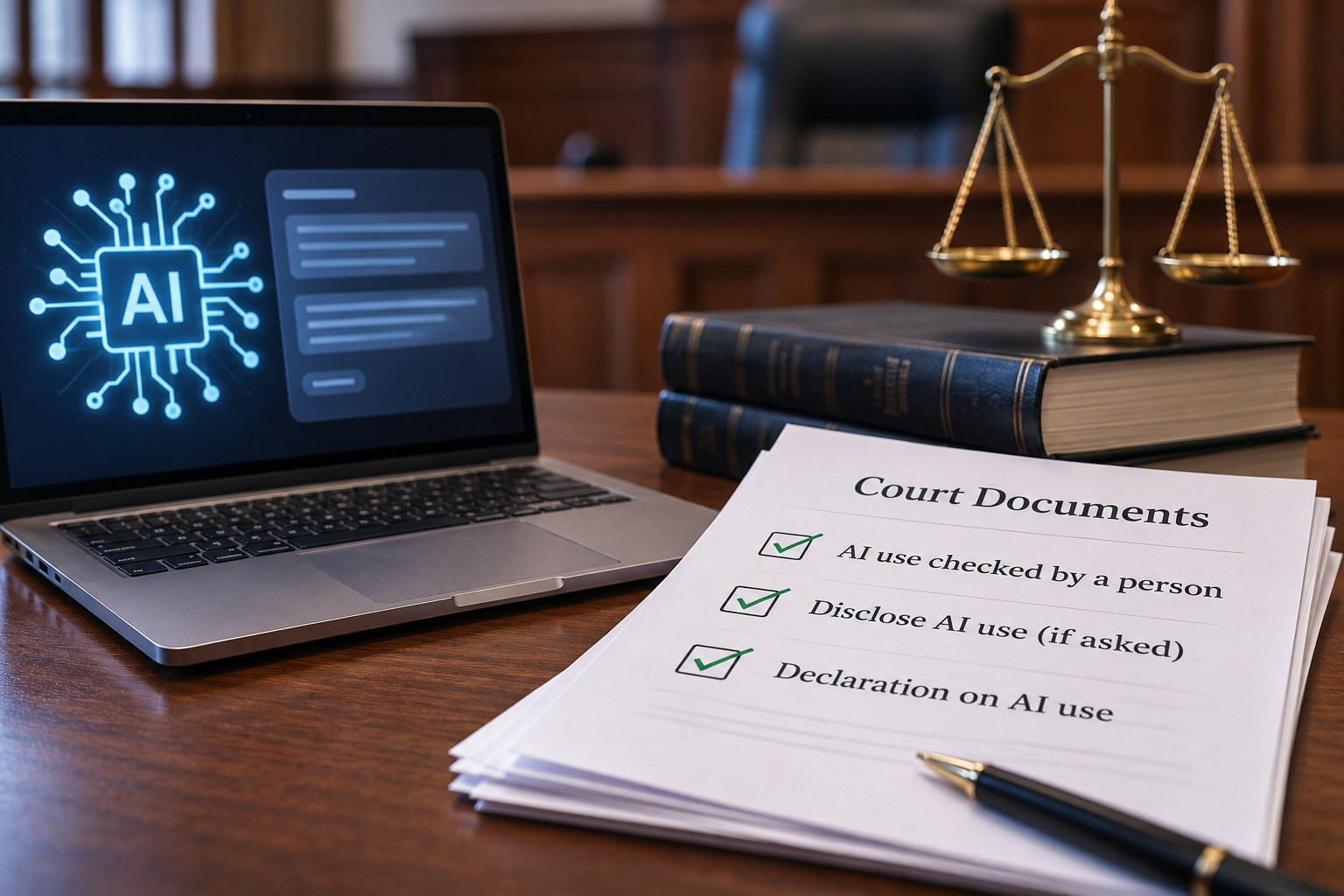
Anyone using generative AI to prepare documents for the Irish courts must now follow new formal rules. Three practice directions set out how AI generative tools can and cannot be used in court proceedings. The message is simple, AI is allowed, but the human remains fully responsible for what goes before the court.
What the new rules require
The directions cover all documents in civil proceedings, from pleadings and affidavits to witness statements and expert reports. They apply to solicitors and barristers and to people representing themselves alike. In short the rules are as follows:
- Anything produced with AI must be independently checked by a person, not by another AI tool.
- Where the court asks, parties must disclose whether and how AI was used.
- Witness statements and expert reports must carry a declaration on the AI use in the document.
Why the courts have acted
The turning point in Ireland was the recent case of Guerin v O’Doherty. This case was decided by the Court of Appeal in March 2026. A litigant representing themselves used AI to prepare their submissions, which cited legal cases that did not exist. These AI hallucinations went unchecked until they were submitted before the court and the other side ran up extra costs trying to find them. The court did not penalise the litigant, as no guidance existed at the time on AI use in court proceedings, but it set out principles of responsible use. The new practice directions make those principles formal and enforceable.
Underlying this is a simple longstanding legal principle, that judges must be able to trust every document put before them.
What this means in practice
For anyone involved in a court case, the message is to treat AI as a potential tool and never a finished product. Check every fact and source, be ready to explain how AI was used, and think twice before entering confidential information into any AI tool.
The last point carries real legal risk. If you upload personal details about yourself or others to a public AI tool this can breach GDPR, as that data may be stored or reused outside of your control.
In family law cases the stakes are even higher still. Family proceedings are held in – camera, and sharing case documents or details with an AI platform could breach the in-camera rule, which is designed to protect the privacy of the parties involved, particularly children, ensuring sensitive matters are not exposed to public record.
The human touch still matters
At Dillon Solicitors LLP, we understand why so many people now turn to AI for answers. It is quick, free and available at any hour, and when you are facing a legal problem, it is natural to want information straight away.
But AI is no substitute for a solicitor. It cannot draw on years of experience and professional training, and it cannot be held to the duties we owe to our clients and to the courts. As the Guerin case shows, it can also be confidently wrong.
Just as importantly, AI lacks the human touch. Legal problems are rarely just legal, they affect families, livelihoods and peace of mind. Our team takes the time to understand your circumstances, weigh the nuances an AI machine would miss, and give advice that fits your situation, not a generic answer based on algorithm and internet searches.
If you have a legal question, AI might be a place to start, but speak to us before you act on what it tells you. We are available on 012960666 or at info@dillon.ie

